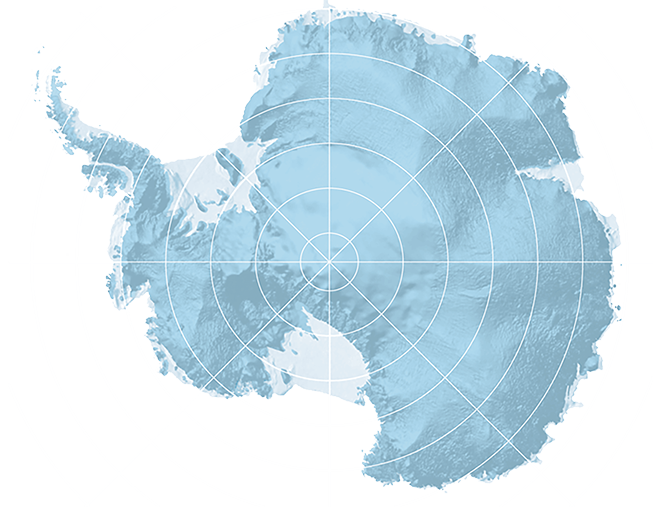
As our 2009 season draws to a close it's rewarding to reflect on the success of our guests and what we've accomplished over the past three months. With the exception of a severe windstorm at the start of the season, we enjoyed exceptionally good Antarctic weather, including a record high temperature at Base Camp. The good conditions meant our flights to Antarctica left with very few delays. Expeditions got off to a good start with the first groups heading into the field on November 12.
On January 15, 2010, Meagan McGrath became the first Canadian to ski solo and unsupported to the South Pole. She completed her trip from Patriot Hills in 40 days. Meagan had a rough start to her expedition, falling in a crevasse on day two. Fortunately she suffered only minor injuries and after a few days rest, began again. Meagan reported from the South Pole that the mental challenges of the trip were far harder than she expected.
Seven women on the Kaspersky Commonwealth Antarctic Expedition claimed more than a handful of firsts as they arrived at South Pole on December 29, 2009 after 40 days of travel. They are the first citizens of Brunei and Cyprus and the first women from India, Singapore, and New Zealand to ski to the Pole. Expedition leader Felicity Aston and her team want to send the message to everyone that: "If we can do this then you can do anything that you like." The team was met at the South Pole by their main sponsor.
Cecilie Skog and Ryan Waters completed the most challenging expedition of the season, a traverse of the continent from Berkner Island to the South Pole then on to the Ross Ice Shelf by skiing down the Axel Heiberg Glacier. Skog and Waters made steady progress, throughout their ambitious expedition navigating hazards with care and competence. Temperatures plummeted as they ascended to 3200m on the Titan Dome, just beyond the South Pole. And they backtracked to safer ground when they found themselves on "The Devil's Dance Floor", a heavily crevassed area that also troubled Amundsen nearly 100 years ago. They waited for good visibility to tackle the final obstacle, the descent down the Axel Heiberg Glacier to the Ross Sea, reporting afterward that they were tired but satisfied to see the finish just below them. The team completed their trip without any re-supplies and without the aid of kites.
The two Danes Morten Grundsoe and Jens Erik Neilsen arrived at the South Pole on December 29, 2009 after a speedy 30 days of skiing. Their expedition from the Filchner-Ronne Ice Shelf to the South Pole aims to draw attention to the impacts of climate change in polar regions.
Brazilian Julio Fiadi was less fortunate in his third attempt at the Pole. Fiadi had to give up his expedition after equipment difficulties hampered his progress.
ALE guide Eric Larsen and his two teammates, Canadian Liu Dong Sheng and Irish/Canadian William Hanlon found humor during their 48 day Ski South Pole Expedition. In one podcast Eric explained how each time Dong Sheng went out of the tent and returned he would say, "It's me!" as if there might be someone else dropping by in the middle of Antarctica! Eric hopes the expedition "will tell the story of these remote places so we can better understand how our actions affect the poles and ultimately the planet".
ALE Guide Hannah McKeand and her Canadian teammate Armold Witzig overcame blisters and binding problems to complete their Ski South Pole (Messner Start) Expedition in 39 days.
A number of Ski Last Degree groups also completed expeditions, skiing the last 60 nautical miles to the South Pole. 44 less hardy, but no less adventurous guests flew to the South Pole, a remarkable experience in itself. On Vinson 121 climbers scaled the highest peak in Antarctica. Mt. Shinn and several sub-peaks of Vinson Massif also saw ascents.
The 5th Antarctic Ice Marathon saw 19 competitors from 11 countries test themselves against the elements and each other on a scenic and challenging course. Richard Donovan (Ireland) won the 100km Ultramarathon event. First place in the Men's Marathon was an exciting duel between Jason Wolfe (USA) and ALE's own Marc de Keyser (Belgium). Wolfe pulled ahead over the last 15km to claim the title. Richelle Turner (Austalia) won the Women's Marathon. Complete results can be found at www.icemarathon.com
A real highlight of the season was our Ellsworth Safari program. Four pristine peaks were climbed during the 12 day tour of the spectacular Henderson Glacier and Horseshoe Valley areas. Our guides enthuse that it's one of our best programs: A custom-tailored itinerary offering unparelled climbing and skiing, through untracked terrain, with unlimited views. What's not to like?
ALE was pleased to continue our support for Antarctic research. We provided flight and landing support for Twin Otter and C-130 Hercules aircraft as well as meals and accommodation for flight crews and field staff involved with the United States Antarctic Program's Polenet project. http://antarcticsun.usap.gov/science/contenthandler.cfm?id=1453
We also supported Argentine research by flying station personnel to and from Belgrano II station. The station is usually supplied by ship but the Argentine icebreaker is temporarily out of service and personnel exchange was accomplished via ALE aircraft for the first time. This allowed staff rotation to occur in November, well before the icebreaker would normally reach the station.
We have been very pleased with our new Base Camp facilities. This year saw the installation of a new snow melter, a men's urinal and heavy lifting equipment to make loading and unloading aircraft easier. The new snow melter produces ample hot water for camp, with minimum environmental effects. The new urinal provides a more comfortable toilet space and facilitates human waste removal from Antarctica.
Now camp is packed away for the winter and we're planning for 2010 and the new adventures it will bring. We hope to see you down on the ice. |